

We often talk about wanting a balanced life.
A fulfilling career.Good health.Meaningful relationships.Time for ourselves.A sense of purpose.
And yet, there are times when life can look perfectly fine from the outside and still feel strangely unsettled within.
You may be doing everything you are supposed to be doing. You may have achieved many of the things you once wanted. And yet, something feels off.
Perhaps what we are looking for is not simply balance.
Perhaps it is alignment.
What does it mean to be aligned?
Alignment, in its simplest sense, is about things moving in the same direction.
Think of the wheels of a car. When they are aligned, the car moves smoothly in the direction it is meant to go. When they are not, the car may still move, but there is resistance. It may pull to one side. The journey becomes less effortless, and over time, the imbalance can affect other parts of the system.
Life can be much the same.
Life Alignment is the process of bringing greater coherence between what we value, what we need, what we feel, how we live, and who we are becoming.
It is not about having a perfect life.
It is about whether the life we are living is broadly in harmony with what is important to us.
When what we value and how we live begin to move in different directions, we experience a form of misalignment.
And sometimes, we don’t recognise it immediately.

Story Of Meera
Imagine a woman in her early forties. Let’s call her Meera.
Meera has a good life by most measures.
She has a career she has worked hard to build, a family she loves, a comfortable home and a busy but fairly organised routine.
She knows the basics of healthy living. She tries to eat well. She knows she should exercise. She understands that sleep matters.
But lately, she has been feeling tired.
She eats her meals while answering messages or thinking about the next thing on her list. Exercise keeps getting postponed because there is always something more important to do. She says yes when people need her, even when she is already exhausted.
And when she finally gets some time for herself, she often doesn’t know what to do with it.
Her first thought is:
“I need to get my health back on track.”
So perhaps she needs a better diet.
More exercise.
More discipline.
But when she pauses and looks at her life more closely, she begins to notice something else.
She values her health, but her everyday life leaves very little room for caring for herself.
She values meaningful relationships, but she is often too mentally exhausted to be truly present.
She values peace, but her days are built around constant urgency.
She values being there for the people she loves, but she has gradually made herself available to everyone except herself.
Nothing is necessarily wrong with Meera’s life.
But there is a growing distance between what matters to her and the way she is actually living.
That distance is misalignment.
And recognising it changes the question.
Instead of asking only,
“What should I do about my health?”
she can begin asking,
“What is happening in my life that is making it so difficult for me to care for myself?”
That is a very different starting point.
Life Alignment is not a destination
It is tempting to think that once we have everything “sorted”, we will finally be aligned.
But life doesn’t stay still.
We change.
Our circumstances change.
Our relationships change.
Our responsibilities change.
Our bodies change.
Our priorities change.
What felt right at twenty-five may not feel right at forty.
A career that once gave us purpose may eventually begin to drain us.
A way of relating to our family that once worked may no longer work as our relationships evolve.
A lifestyle that once suited us may become incompatible with what our body needs today.
This is why Life Alignment is not a destination we arrive at once.
It is an ongoing process.
A process of noticing, understanding and realigning as life changes.
Sometimes realignment requires a significant change.
Sometimes it begins with something very small.
The important thing is to recognise what has changed and respond consciously rather than continuing on autopilot.
So, where do we begin?
Once we recognise that something in our life doesn’t feel aligned, our natural instinct is often to fix it immediately.
But perhaps the first step is not to fix.
The first step is to identify.
Where exactly is the misalignment?
Is it in our physical wellbeing?
Our emotional world?
Our lifestyle?
Our relationships?
Our sense of purpose?
Or somewhere deeper?
And perhaps even more importantly:
How many other areas of life is this affecting?
Because our lives don’t exist in separate compartments. A physical concern may have a lifestyle pattern behind it.A lifestyle pattern may be influenced by an emotional pattern. An emotional pattern may be connected to our relationships, beliefs or expectations. One area can create ripples across several others.
This is what happened with Meera.
What first appeared to be a health concern was connected to the way she was living, the boundaries she was setting, the expectations she carried and the importance she had gradually given to everyone else’s needs over her own.
The more clearly she could see these connections, the more meaningful her path towards change could become.
Seeing the different spheres of life
There is no single formula for alignment. But it can help to pause and look at a few fundamental spheres of life.
Our physical wellbeing — How are we nourishing, resting and caring for our body?
Our emotional wellbeing — What are we feeling? What patterns keep repeating? Are we listening to what our emotions may be telling us?
Our lifestyle — Does the way we structure our days support the life and wellbeing we say we want?
Our relationships — Where do we experience connection, strain, responsibility, expectations or difficulty with boundaries?
Our values and purpose — Are our choices connected to what genuinely matters to us?
These spheres are interconnected. And alignment does not mean that every sphere will always feel perfect. It means that we become aware of where there is a disconnect, understand the relationship between the different areas, and consciously decide where to begin.
What needs to change?
From awareness to a plan
Once we have identified where the misalignment lies, the next question becomes:
What needs to change?
But even here, more change is not necessarily better. The aim is not to overhaul your entire life overnight. It is to understand the pattern and identify where a meaningful shift can begin. Perhaps one area needs immediate attention. Perhaps several areas need to be addressed together. Perhaps one small change in one sphere could create a positive ripple into others.
A useful plan therefore begins with understanding:
What is misaligned?
What is contributing to it?
What else is it affecting?
What is within my control?
Where would a meaningful first shift begin?
But even here, more change is not necessarily better. The aim is not to overhaul your entire life overnight. It is to understand the pattern and identify where a meaningful shift can begin. Perhaps one area needs immediate attention. Perhaps several areas need to be addressed together. Perhaps one small change in one sphere could create a positive ripple into others.
A useful plan therefore begins with understanding:
What is misaligned?
What is contributing to it?
What else is it affecting?
What is within my control?
Where would a meaningful first shift begin?
And then, importantly, the process doesn’t end there. Because once life changes again, we may need to pause, reassess and realign again. That is the nature of Life Alignment.
Sometimes, what we need is not another solution — but a clearer understanding of what is actually out of alignment.
At OliveByRenuka, this is where Life Alignment & Wellness Architecture begins: understanding the patterns, connections and areas of life that may be affecting your wellbeing — and finding a way forward that is right for your life.
Perhaps this is what wellbeing really asks of us
We often ask:
What should I eat?
How should I exercise?
How can I reduce my stress?
What should I change?
These questions have their place.
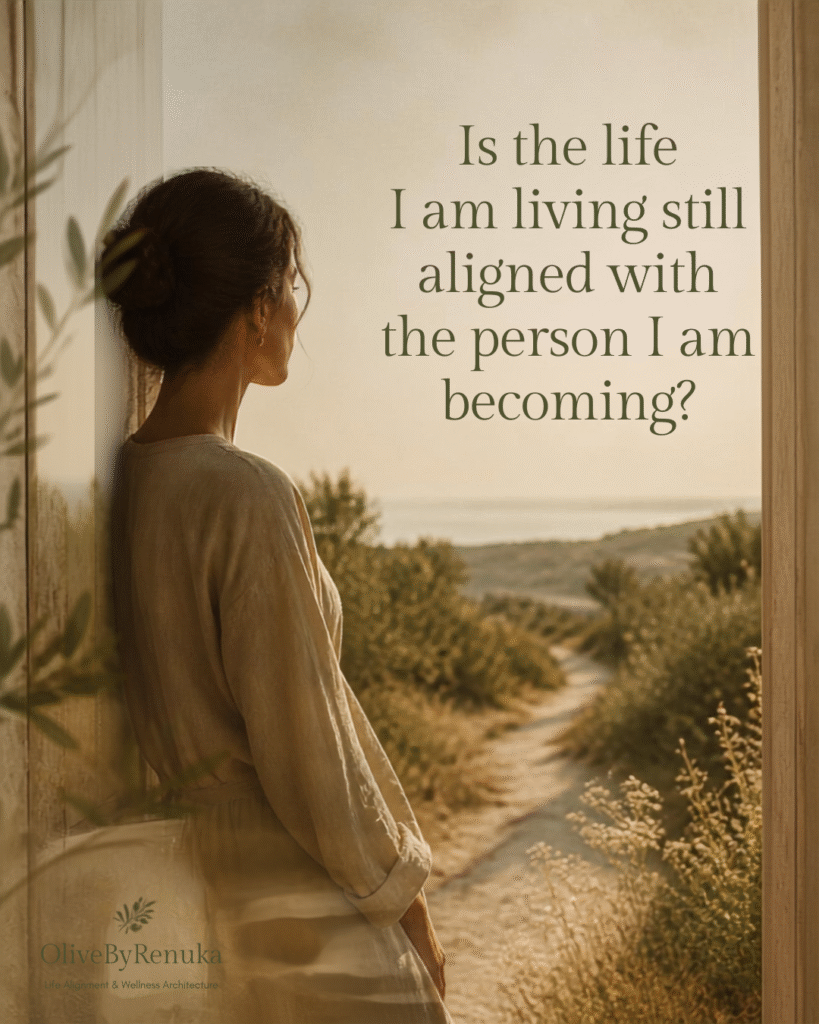
“Is the way I am living aligned with what I truly need and value at this stage of my life?”
But sometimes, a deeper question needs to come first:
“Is the way I am living aligned with what I truly need and value at this stage of my life?”
And if the answer is no, we don’t need to judge ourselves for it.
We simply need to become curious.
To notice.
To understand.
To see the connections.
And then to consciously choose what we want to realign.
Perhaps being truly aligned does not mean finding the perfect way to live. Perhaps it means developing the awareness to recognise when we have moved out of sync — and the willingness to find our way back.
Not changing everything.
Understanding what matters. Seeing the patterns. And bringing the different parts of life into greater alignment.
That, to me, is where meaningful wellbeing begins.
And then the most important question is not:
“Is my life working?”
But:
“Is the life I am living still aligned with the person I am becoming?”